Presentation Packs
This category lists editable training resources that include more than a presentation.
Are these training packs editable? Yes, every resource is fully editable so you can adapt it to your service, training style and policies.
Do these packs include lesson plans? No - these are not courses, they are resources for use in your own sessions.
Presentation Packs
Fire Safety Awareness Training ResourcesFire Safety Awareness (With printable Fire Safety Policy Template) Includes Guide for Staff and Visitors, End of Session Multiple Choice Assessment Sheet. Suitable for Induction and Refresher training Presentation 1 Fire Safety Awareness (39 slides) Slide Titles: Aims and Objectives Understanding Fire Fire Triangle Heat Fuel Oxygen Prevention and Control Summary and Recap Discovering a Fire A Fire Hearing the Fire Alarm Discovering a Fire Smoke Dealing with a Fire Fire Extinguishers Fire Extinguisher Labels Water Extinguishers Carbon Dioxide Extinguishers Spray Foam Extinguisher Dry Powder Extinguishers Suitability and Labels Summary and Recap) Word Documents Handout to accompany the presentation Class F Fires and Wet Chemical Extinguishers Fire Extinguishers Important Information Fire Extinguishers Provision and Siting How to Use a Fire Extinguisher Fire Safety Guide (Staff and Visitors) Template Fire Safety Policy Template Certificate of Training Template End of Session Multiple C...
Presentation Packs
Fire Safety Risk Assessment Residential and Day Care Settings Training ResourcesFire Safety Risk Assessment Residential and Day Care Settings Fire Risk Assessment training pack for all health and social care settings. Includes a training presentation (large and fully comprehensive), Fire Risk Assessment Template (7 pages) and 17 page fully comprehensive handout. Presentation 1 Fire Safety Risk Assessment (82 Slides) Slide Titles: Aims and Objectives Introduction What is Residential Care ? Who Should Be Aware of What Regulatory Reform (Fire Safety Order) 2005 (England and Wales) Responsibilities Who Is The Responsible Person Who Else Has Responsibilities? Health and Safety at Work Act 1974 Fire Risk Assessment Overview The Responsible Person The Fire Risk Assessment Things To Consider Help With the Assessment Aims of the Assessment Hazards and Risks Fire Safety Risk Assessment Step One Identify Fire Hazards Fire Triangle Heat Ignition Sources in Care Settings Fuel Sources Fuel Sources in Care Settings Oxygen Sources Step One identify Fire Hazards Step Two Identi...

Presentation Packs
Fire Safety Safe Use of Emollient Creams Training ResourcesPowerPoint presentation and Word Document handout and Generic End of Session Assessment. Safe Use of Emollient Creams (34 slides) - slide titles: Aims and Objectives Introduction What are Emollients? What Is The Risk? How Big Is The Risk? Mechanism of the Risk Which Emollient Products Are Affected? Do's and don'ts advice for staff and for staff to give to clients/residents/patients/relatives/informal carers Advising Patients, Clients, Relatives and Carers Smoking Clothing and Bedding Furniture Fire Safety Fire Safety Law Fire Safety Training Fire Risk Assessments Individual Fire Risk Assessments of Residents/Clients Mental Capacity Act Mental Capacity Act and Fire Safety Individual Fire Risk Assessments Incidents in Care Homes Coroner Report involving Emollients Incident at a Care Home Things to Check CQC Learning from Safety Incidents CQC (Registration) Regulations 2009: Regulation 18 Yellow Card Scheme References Word Documents 9 page handout Generic end of session easy assessment...

Presentation Packs
Fluids and Nutrition Domiciliary Care Level 1 Training ResourcesFluids and Nutrition Domiciliary Care Level 1 Training Resources Presentation, Handout, Knowledge Check Questions, Trainer Aide Answer Key. All files editable. Overall aim: To understand why fluids and nutrition are important and how care staff can support people to eat and drink safely in their own homes. Learning outcomes: Why eating and drinking are important. Why people need enough fluids. Ways to support people to eat and drink. Know that people have different food and drink needs. When there may be a concern about eating or drinking. Who to tell if there is a concern. Presentation (38 Slides) - Slide Titles: Aim and Objectives Introduction Why Are Fluids and Nutrition Important? What Do We Mean by Nutrition and Hydration? What Happens When We Do Not Get Enough to Eat or Drink? Good Hydration and Nutrition Why Do We Need Fluids? Dehydration Possible Signs of Dehydration Supporting People to Drink Why Is Good Nutrition Important Supporting People to Eat at Home Why Is Good Nutri...

Presentation Packs
Fluids and Nutrition Residential Care Level 1 Training ResourcesFluids and Nutrition Residential Care Level 1 Training Resources Presentation, Handout, Knowledge Check Questions, Trainer Aide Answer Key. All files editable. Overall aim: To develop staff awareness of the importance of fluids and nutrition and how they can support people living in residential care to maintain hydration, eat well and have their individual dietary needs respected. Learning outcomes: Why eating and drinking are important. Why people need enough fluids. Ways to support people to eat and drink. Know that people have different food and drink needs. When there may be a concern about eating or drinking. Who to tell if there is a concern. Presentation (34 Slides) - Slide Titles: Aim and Objectives Introduction Why Are Fluids and Nutrition Important? What Do We Mean by Nutrition and Hydration? What Happens When We Do Not Get Enough to Eat or Drink? Good Hydration and Nutrition Why Do We Need Fluids? Dehydration Possible Signs of Dehydration Supporting People to Drink Why Is...
Presentation Packs
Food Allergies Awareness Level 1 Training ResourcesFood Allergies Awareness Level 1 Training Resources Presentation, Handout, Knowledge Check Questions, Trainer Aide Answer Key. All files editable. Overall Aim: To understand how to help keep people with food allergies safe. Learning Outcomes: By the end of the session, learners will be able to: Know what a food allergy is. Recognise common signs of an allergic reaction. Know how to help prevent allergic reactions. Know what to do if someone has an allergic reaction. Presentation (36 Slides) - Slide Titles: Overall Aim and Learning Outcomes Introduction Food Allergy vs Food Intolerance How Does a Food Allergy Affect the Body? Common Food Allergens in the UK Recognising Signs and Symptoms Mild to Severe Reactions and Anaphylaxis Diagnosis and Medical Support Managing Food Allergies in Daily Life Food Labelling and Allergen Information Avoiding Cross-Contamination Eating Out and Takeaway Food Safe Alternatives and Substitutions Supporting People with Food Allergies Staff Roles and Resp...
Presentation Packs
Food Hygiene Awareness Training ResourcesFood Hygiene Awareness 6 PowerPoint presentations and 24 Word documents (Handouts and Learning Activities) Suitable for trainers, training agencies, care settings, care staff and for use on full and part time courses including QCF. Presentation 1 The Basics Slide Titles: - Why is Food Hygiene Important? - Symptoms of Food Poisoning - Who is at Risk? - The 4 Cs - Cleaning - Cooking - Chilling - Cross-contamination - Hand Washing - Effective Hand Washing - Preventing Cross - contamination - Summary - References Presentation 2 The Principles Slide Titles: - The Importance of Food Hygiene - What Does Keeping Food Safe Involve? - Who Handles Food in a Care setting? - What is Food Poisoning? - What Causes Food Poisoning? - Vulnerable Groups - Babies and Young Children - The Elderly - Pregnant Women - People who are ill - Symptoms of Food Poisoning - Food Poisoning Statistics - Good Working Practices - Summary - References Presentation 3 The Practice Slide Titles: - General Principles - Ro...
Presentation Packs
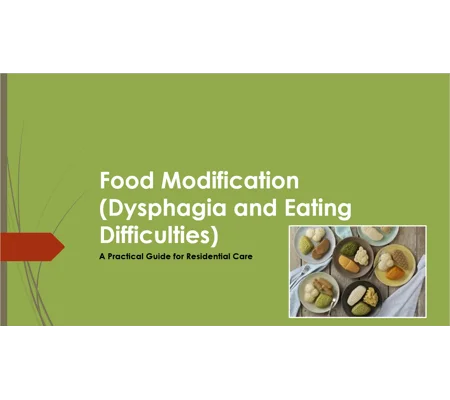
Food Modification for Eating Difficulties Training ResourcesFood Modification (Dysphagia and Eating Difficulties) - A Practical Guide for Residential Care Health ad Social Care Teaching/Training Resources All fully editable. Presentation in sections you can choose which sections to use. Aims and Objectives included if you want to use the presentation as it has been written. Comes with a 26 Page Master Handout, 8 Handouts of the Sections covered and a Multiple Choice End of Session Assessment. Aims and Objectives: Overall Aim: To enhance awareness and provide practical knowledge for Residential Care and Kitchen Staff on food preparation and design for individuals with swallowing difficulties. Learning Objectives: Understand the challenges faced by individuals with swallowing difficulties in food consumption. Identify appropriate food adaptations and design considerations for individuals with swallowing difficulties. Learn techniques and strategies for food preparation tailored to individuals with swallowing difficulties. Demonstrate proficien...
Presentation Packs
Frailty Awareness Training ResourcesUnderstanding Frailty in Health and Social Care Recognising and Supporting People Living with Frailty Presentation, Handout, End of Session Knowledge Check Questions (multiple choice), Trainer Aide Answer Key. All files editable Overall Aim: To raise awareness of frailty, its impact on people s health and wellbeing and the importance of early identification and person- centred care across all health and care settings. Learning Objectives: By the end of this session, participants will be able to: Understand frailty and its impact on health, daily life and care needs. Recognise and categorise frailty using the Electronic Frailty Index (eFI) and observable signs. Apply person-centred approaches and adapt care, communication and environments in multi-disciplinary settings. Presentation (29 Slides) Aims and Objectives Introduction What is Frailty? Why Understanding Frailty Matters Frailty Across the Care Pathway The Electronic Frailty Index (eFI) Signs and Indicators of Frailty Impact on...
Presentation Packs
Gastroparesis Awareness Training ResourcesGastroparesis Awareness - Health and Social Care Staff (including Care Workers, Nurses and Support Staff) Presentation, Handout, Knowledge Check Questions, Trainer Aide Answer Key All files editable. Overall Aim: To raise awareness and understanding of gastroparesis among health and social care staff, enabling them to recognise symptoms, provide safe and compassionate support and work effectively with healthcare professionals to promote nutrition, wellbeing and timely escalation of care. Learning Objectives: Define gastroparesis and understand its causes. Recognise common signs and symptoms. Understand how gastroparesis is diagnosed and managed. Support individuals living with gastroparesis safely and empathetically in care settings. Identify when to seek medical help or escalate concerns. Presentation (43 Slides) Aims and Objectives What Is Gastroparesis? Causes of Gastroparesis - Long Term Diabetes Causes of Gastroparesis Post-Surgical Nerve Damage Causes of Gastroparesis Neurolog...
Presentation Packs
Glaucoma Awareness Training ResourcesGlaucoma Awareness Presentation and Word Documents (all files editable). Presentation - Glaucoma (24 Slides): Aims and objectives Introduction What is glaucoma? Types of glaucoma Open angle glaucoma Closed angle glaucoma Secondary glaucoma Congenital glaucoma Pressure and the eyeball Preventing glaucoma? Risk factors Treatment Aim of glaucoma Treatment open/closed angle glaucoma Treatment open angle glaucoma (laser) Treatment closed angle glaucoma (laser) Treatment surgery Surgery advantages/disadvantages Medication Summary References Word Documents Handout End of Session Example Assessment and Answer Sheet HSC Training Link Training Resources for Health and Social Care Supplying training resources for the health and social care sector since 2004. Resources purchased are emailed to you via Zip Folder attachment. All packs are written in a generic style and can easily be adapted to suit your own specific training delivery. Resources are Microsoft Office based. Secure payments via Pay...
Presentation Packs
Glucagon Emergency Medication Training ResourcesMedicines - Emergency Medication Glucagon Also gives underpinning knowledge on Severe Hypoglycaemia as well as procedures for administration and management of Glucagon. Presentation, Handout, Knowledge Check Questions x 2, Trainer Aide Answer Key x 2 (one knowledge check is for staff not authorised to administer Glucagon). All files editable. Overall Aim: To equip health and social care staff with the knowledge and confidence to recognise severe hypoglycaemia and safely administer glucagon, while providing appropriate post-administration care and escalation. Learning objectives: Recognise the signs and risks of severe hypoglycaemia. Identify when glucagon is indicated and when it is not. Safely prepare and administer glucagon according to current guidance. Monitor the individual and manage care following administration. Escalate appropriately and document the incident in line with local policy. Presentation (68 Slides) Aims and Objectives Introduction Registered Healthcare Professio...
Presentation Packs
Gold Standards Framework Awareness Training ResourcesGold Standards Framework Awareness Presentation (in sections), Handout and End of Session Assessment (Multiple Choice). All editable to suit your training session and audience should you wish to edit. This presentation (54 slides) is in sections). The session can be used as it has been written or you can choose to use specific sections. Aims and Objectives: Overall Aim: To equip health and social care staff with the knowledge and practical skills needed to implement the Gold Standards Framework (GSF) in end-of-life care, ensuring high-quality, coordinated and compassionate care for patients. Learning Objectives: Understand the key principles and core components of the Gold Standards Framework in end-of-life care. Identifying patients in the last year of life using the GSF tools and criteria. Skills to create and review personalised care plans in collaboration with patients and families. Strategies for effective communication and coordination within multidisciplinary care teams to im...
Presentation Packs
GORD (GERD) Awareness Training ResourcesGORD Awareness - Residential and Domiciliary Care (Gastro-Oesophageal Reflux Disease) Presentation, Handout, End of Session Assessment (mix of Multiple Choice, True/False and Short Answer questions), Trainer Aide Answer Key. All files editable. Aims and Objectives Overall Aim: To raise awareness and understanding of GORD to support the recognition, reporting and day-to-day care of individuals living with the condition in adult residential and domiciliary settings. Learning Objectives: Recognise the common signs, symptoms and potential impact of GORD in adults receiving care. Understand the general factors that can contribute to or worsen GORD in care settings. Identify simple care strategies and when to report concerns to help manage GORD effectively. Presentation (53 Slides) Aims and Objectives Welcome Introduction to GORD Why Staff Need an Awareness of GORD Section - Causes and Risk Factors of GORD Common Causes of GORD Risk Factors Common in Adults in Care What is the LES? Releva...

Presentation Packs
Grief and Bereavement Awareness Training ResourcesTheories of Grief & Bereavement Awareness PowerPoint presentations and Word documents. A training resource focusing on concepts of loss (stages of grief outlined by Kubler-Ross, Bowlby, Freud, Stroebe and Schut, Parkes and Warden) and aspects of bereavement (what it is, common responses, emotional, physical, behavioural and mental reactions, resolution of grief). Presentation 1 Theories of Grief Awareness (54 slides) This session looks at theories of grief and bereavement By the end of the session learners will have an awareness of: Kubler-Ross 5 Stages of Grief Model Bowlby 4 Stages of Grief Model Freud Theory of Mourning Parkes Psychosocial Transitions Stroebe and Schut Dual Process Model Worden Tasks of Grief Model They will also gain an awareness of the differences between types of theories and symptoms and experiences of the stage theories. Slide Titles: Aims and Objectives Introduction KublerRoss Her Work Kubler - Ross Five Stage Model 5 Stage Grief Model Denial 5 Stage Grief...

Presentation Packs
Grooming Awareness Training ResourcesSafeguarding - Grooming Awareness - Training Resources Presentation (in Sections), 8 Handouts, End of Session Multiple Choice Assessment Overall Aim: The aim of this session is to educate the audience about the signs and dangers of grooming, empowering them to recognise and respond to potential cases of exploitation and abuse. Learning Objectives: Understand the definition of grooming and its various stages. Identify common signs and indicators of grooming in vulnerable individuals, especially children. Creating a safe and supportive environment for open communication about grooming concerns. Reporting suspected grooming or child sexual abuse Presentation (76 slides) Aims and Objectives Introduction What is Grooming? Stages of Grooming Section - TARGETING Section - BUILDING TRUST Section - ESTABLISHING A RELATIONSHIP Section - ISOLATING THE VICTIM Section - SECRECY AND MANIPULATION Section - EXPLOITATION Section - RECOGNISING THE SIGNS OF GROOMING Section - PREVENTION & INTERVENTION...
Presentation Packs
Health and Safety Domiciliary Care Training ResourcesDomiciliary Care - Health and Safety Overview Suitable for domiciliary care settings, homecare, trainers, training agencies and training courses (including QCF Diploma). An overview of the health and safety issues (see list below) faced by domiciliary care staff and includes legislation and risk assessment, employers legal duties, induction and training, main health and safety issues. Presentation (50 slides) (with session hand-out) Slide Titles: Aims and Objectives Introduction Where to Start A Range of Duties Vulnerability Policies and Procedures Employers Legal Duties Risk Assessment Range of Risk Assessment Training and Information Induction Additional Training Equal Access to Information Passive Smoking Manual Handling Manual Handling Risk Assessment Medication Infections Infection Control Personal Protective Equipment PPE Gloves Lone Working Lone Working Risk Assessment Lone Working Driving Violence General Health & Safety Aspects References Further Information Word Document S...
Presentation Packs
Health and Safety First Aid Regulations Training ResourcesUnderstanding the Health & Safety (First Aid) Regulations 1981 - Managers and Health and Safety Managers of Care Settings Enough resources for single sessions, single aspects or a one day course with workshops. All editable. Can be used 'as is' or adapt for your own tailored session. 32 files in total - Presentation (in sections), End of Session Assessment, 10 Handouts, 10 Learning Activities, 10 Trainer Aides for Activities (with answers). Aims and Objectives: Understand the requirements of the First Aid Regulations 1981 Define roles and responsibilities of employers and managers Apply best practice in care environments Ensure compliance and preparedness Presentation (130 Slides) Aims and Objectives Introduction Section - Legal Overview Legal Overview Health and Safety (First-Aid) Regulations 1981 Key Objectives of the Regulations Employer Responsibilities Types of First-Aid Personnel Training Requirements First-Aid Equipment Risk Assessment and Specific Considerations Compliance a...
Presentation Packs
Health and Safety for Office Staff Training ResourcesHealth and Safety in Office Environments Awareness - Promoting Safe Working Practices Suitable for all settings Enough resources for full sessions, single aspects or a workshop. 12 Files in total (Presentation (in sections) , Handouts x 3, Learning Activity documents x 6 (some case study based) and End of Session Assessment with Trainer Aide Answer Key. Presentation also includes interactive discussion questions. All files editable. Aims and Objectives: Overall Aim: To ensure all office-based staff in care and childcare settings understand and can apply key health and safety principles to maintain a safe and compliant working environment Learning Objectives: Identify common health and safety risks relevant to office-based roles in care and childcare environments. Apply safe working practices in line with legal and organisational health and safety requirements. Respond appropriately to incidents, hazards and near misses using correct reporting procedures. Presentation (101 Slides) Ai...
Presentation Packs
Health Related Fixations Supporting Children and Young People Training ResourcesSupporting Young People and Children with Health Related Fixations Health Related Anxiety or Somatic Symptom Fixation Awareness, Tools and Strategies for Support Workers Enough resources for full sessions, single aspects or a one day course with workshops. All editable. 14 Files in total (Presentation (in sections) , Handouts x 4, Learning Activity documents x 7 and End of Session Assessment with Trainer Aide Answer Key. Aims and Objectives: Overall Aim: To equip support workers with the knowledge and skills to respond effectively and compassionately to young people who hold inaccurate beliefs about their health, while promoting emotional well-being and psychological flexibility. Learning Objectives: Understand why children/young people may believe they have medical conditions they don't have Learn how to respond empathetically without reinforcing false beliefs Gain practical strategies to support emotional regulation and resilience Know when and how to involve clinical professional...

Presentation Packs
Healthy Bowel Function Awareness Training ResourcesHealthy Bowel Function - Steps to Take and Underpinning Knowledge Health and Social Care Training Resources All fully editable. Presentation in sections you can choose which sections to use. Aims and Objectives included if you want to use the presentation as it has been written. Comes with 9 Handouts and a multiple choice end of session assessment. Overall Aim: To equip health and care staff with knowledge and practical strategies for promoting and maintaining healthy bowel function among individuals under their care. Learning Objectives: Understand the importance of regular bowel movements Promote adequate fibre intake for bowel health Learn about gastrointestinal disorders and their impact Emphasise the importance of hydration for bowel regularity Presentation (87 Slides) Presentation (93 slides) Aims and Objectives Introduction SECTION - Regular Bowel Movements SECTION - Adequate Fibre Intake SECTION - Gastrointestinal Disorders SECTION - Hydration SECTION - Proper Diet SECTION -...

Presentation Packs
Healthy Living for People with Type 2 Diabetes Training ResourcesDiabetes - Healthy Living for People with Type 2 Diabetes Presentation, 2 x Handouts, End of Assessment Questions and Trainer Aide Answer Key. All files editable. Overall Aim: To raise awareness of healthy lifestyle choices that help people with type 2 diabetes manage their condition and improve their wellbeing. Learning Objectives: Explain the impact of type 2 diabetes on the body and potential complications. Identify healthy eating principles and practical strategies for blood glucose control. Describe the benefits of regular physical activity and ways to incorporate it into daily life. Recognise the importance of weight management and safe approaches to achieving it. Understand how medicines, monitoring and routine checks support diabetes management. Recognise the role of emotional wellbeing in managing type 2 diabetes. Set realistic, achievable goals to support long-term lifestyle changes. Presentation (37 Slides) Aim and Objectives Understanding Type 2 Diabetes Why Lifestyle Ch...
Presentation Packs
Herbert Protocol Missing Persons Training ResourcesDementia Herbert Protocol Health and Social Care Teaching Resources Presentation and 6 page handout The Herbert Protocol encourages carers, family members and friends of individuals with dementia to gather and record essential information about the person with dementia. This information can be crucial in the event that the person goes missing, as individuals with dementia can become disoriented and confused, making it challenging for them to provide details about themselves. Presentation (41 slides) introduction Herbert Protocol Section - Personal Information Section - Medical Information Section - Daily Routine Section - Key Contacts Section - Safe Place References and Further Information Handout (6 pages) Documents saved in Office, ODF and PDF formats. HSC Training Link Training Resources for Health and Social Care Supplying training resources for the health and social care sector since 2004. Resources purchased are emailed to you via Zip Folder attachment. All packs are written i...
Presentation Packs
Hidden Disabilities Awareness Training ResourcesHidden Disabilities Awareness (Adults) - A Guide for all Staff in All Health and Care Settings Presentation - all fully editable (should you wish to edit). Aims and Objectives included if you want to use the presentation as it has been written. Comes with a Handout and Multiple Choice End of Session Assessment. Aims and Objectives: Overall Aim: To enhance awareness and understanding among Health and Social Care staff of hidden disabilities in adults, enabling them to provide more effective and empathetic care across all adult care settings. Learning Objectives: Identify common types of hidden disabilities in adults and describe their impact on daily life. Apply communication strategies to effectively interact with adults who have hidden disabilities in a variety of care settings. Understand legal and ethical considerations related to supporting adults with hidden disabilities in health and social care settings. Presentation (30 Slides) Aims and Objectives Introduction Hidden Disabil...