
Presentation Packs
This category lists editable training resources that include more than a presentation.
Are these training packs editable? Yes, every resource is fully editable so you can adapt it to your service, training style and policies.
Do these packs include lesson plans? No - these are not courses, they are resources for use in your own sessions.
Presentation Packs
Lithium Safe Management High Risk Medicine Training ResourcesSafe Management of Lithium A High Risk Medicine Care Staff, Nurses and Managers in Adult Social Care Settings Presentation, Handout, Knowledge Check Questions, Trainer Aide Answer Key All files editable. Overall Aim: Promote safe, consistent and informed lithium management in care settings. Learning Objectives: Explain what lithium is and when it is prescribed. Identify key risks associated with lithium therapy. Support safe prescribing, administration and monitoring. Recognise and respond to signs of lithium toxicity. Understand care staff responsibilities in communication and record-keeping. Presentation (48 Slides) Aims and Objectives What is Lithium? Prescription of Lithium Prescribing Responsibilities Care Setting Responsibilities Monitoring Requirements Care Plan and Support Administering Lithium Safety Guidance Recognising Lithium Toxicity Preventing Lithium Toxicity Supporting Individuals on Lithium Roles and Responsibilities in Care Settings SECTION: How Care Staff Can Help...

Presentation Packs
Lone Working Awareness Training ResourcesLone Worker Working Care Home & Domiciliary PowerPoint presentations and Word documents. This pack looks at generic and specific risks, training, emergencies, supervision, the actual risk assessment, recording it and developing safe systems. Presentation 1 - Lone Working Awareness (28 slides) Slide Titles: Introduction Who is a lone worker? Risk Assessment Development of Lone Worker Procedures Risks - Environment Risks Personal Safety Risks - Equipment Risks Medically fit Training Supervision Monitoring staff Emergencies Presentation 2 - Lone Working (Risk Assessment) (17 Slides) Slide Titles: Introduction 5 distinct stages Stages 1 and 2 Stages 3 and 4 Stage 5 Risk assessment principles Factors to consider Recording the risk assessment Developing safe systems Arrangements for managing risk Review of risk assessment References Word Documents (Handouts) Lone worker handout Lone working handout Lone working induction checklist Lone working risk assessment handout HSC Training Link Tea...
Presentation Packs
Long COVID General Awareness Training ResourcesLong COVID General Awareness A general awareness pack for health and social care settings - suitable for all staff. Presentation, Handout, Knowledge Check Questions, Trainer Aide Answer Key All files editable. Overall Aim: To increase awareness and understanding of Long COVID among health and social care staff, enabling them to recognise symptoms, provide effective support and promote recovery for affected individuals. Learning Objectives: Define Long COVID and its recognised symptoms. Understand its potential impact on individuals physical, mental and social wellbeing. Recognise the implications for care planning and workplace support. Identify best practices for supporting people living with Long COVID in health and social care settings. Know where to find reliable guidance and resources. Presentation (42 Slides) Aim and Objectives What Is Long COVID? Prevalence and Impact Recent Data on Long COVID in the UK Common Groups Affected Impact on Quality of Life Common Symptoms Reflecti...
Presentation Packs
Looked After Children (LRC) Framework Awareness Training ResourcesLooked After Children (LRC) Framework Awareness Overview of the framework. Written in easy to understand terms. Presentation, Handout, End of Session Quiz Assessment (mixture of multiple choice, True/False and Short Question Answers). Editable, should you want to tailor it for your own audience. Aims and Objectives: Overall Aim: To raise awareness and provide a basic understanding of the care and support provided to looked after children, including the different types of care settings, their rights and the key people involved in their care. Learning Objectives: Define who looked after children are and recognise the key reasons why children may be looked after. Learn about the roles and responsibilities of key people involved in the care of looked after children and understand their rights. Recognise the importance of stability and routine in the lives of looked after children. Presentation (31 Slides) Aims and Objectives What is Children's Care? What Does Looked After Children Mean?...
Presentation Packs
Making Safeguarding Personal Level 1 Training ResourcesEditable Level 1 resource introducing the principles of Making Safeguarding Personal. Includes a full presentation, handout, quiz and assessment. Ideal for trainers, teachers and care providers delivering safeguarding induction or refresher training.

Presentation Packs
Male Catheterisation Awareness Level 2 Training ResourcesMale Catheterisation Awareness for Care and Support Staff This pack explains what male catheterisation is, who is authorised to perform it and how care staff safely support individuals with catheter care without carrying out the clinical procedure. All files editable, so you can tailor it as required Male catheterisation is not the same as Conveens - conveens are one option for urinary management in men, but they are not catheterisation. Overall aim To build clear, confident understanding of male catheterisation so staff can recognise safe practice, support clinical procedures appropriately, and identify risks that require escalation. Learning objectives Understand what male catheterisation is and when it is clinically required. Recognise the anatomy, risks, and infection prevention principles involved in male catheterisation. Identify the roles, responsibilities, and scope of practice for staff supporting catheter care. Know the correct steps of the clinical procedure and the ratio...

Presentation Packs
Male External Catheters Awareness Training ResourcesIntroduction to Male External Catheters (Conveens) Presentation (29 slides), Handout and 3 End of Session Assessments. Introduction to Male External Catheters Definition and purpose of male external catheters Benefits of using conveens for urinary management Comparison with other types of male urinary catheters Learning Objectives: Define the purpose and benefits of male external catheters Compare and contrast conveens with other types of male urinary catheters Understand the importance of conveens in managing urinary incontinence Slide Titles: Introduction Definition of a Male External Catheter Male External Catheters Benefits of Using Male External Catheters Difficulty Controlling Bladder Inability to Use Traditional Catheterisation methods Mobility and Independence Comfort and Quality of Life Non-Invasive Convenience Lower Infection Risk Reduced Skin Irritation Cost Effective COMPARISON WITH OTHER TYPES OF MALE URINARY CATHETERS Introduction Comparison Factors Method of Insertion...

Presentation Packs
Male Urinary Catheterisation Clinical Awareness & Procedures Training ResourcesMale Urinary Catheterisation Clinical Awareness & Procedures Training Resources 2 Presentations (one of which is Step by Step Procedures), Handout (Summary), Knowledge Check Questions, Trainer Aide Answer Key, Clinical Based Scenario Based Judgements Tests, Trainer Aide Answer Sheet, Clinical Observation Aide All files editable - use what you need. Overall Aim of the Session To provide registered clinicians with the knowledge skill and clinical reasoning required to carry out safe male urethral catheterisation and manage complications effectively in any setting. Learning Objectives LO1 Understand Clinical Indications and Contraindications LO2 Apply Detailed Knowledge of Male Anatomy and Physiology LO3 Perform the Clinical Procedure Safely and Competently LO4 Identify and Manage Complications Promptly LO5 Provide Person Centred Clinical Care During and After the Procedure LO6 Document Clinical Actions Accurately and Lawfully LO7 Apply Clinical Skills Safely Across Different Care Sett...

Presentation Packs
Managing Family Complaints Without Escalation Training ResourcesComplaints - Managing Family Complaints Without Escalation (All Settings) - Core Skkills and Core Risks to be Managed Residential Care, Domiciliary Care, Nursing Homes, Supported Living, Hospital Ward, GP Practice, Mental Health Service, Learning Disability Services, Hospice Care., Community Nursing. Presentation, Handout, Quick Knowledge Check Quiz, , Scenario Cased Learning Activity for all settings listed above, (Trainer Aide Answer Key. All files editable. Overall Aim: To strengthen staff confidence and professionalism when responding to family concerns by developing the communication, emotional awareness and decision making skills needed to resolve issues early, maintain trust and prevent escalation to formal complaints or regulatory scrutiny across all health and social care settings. Learning Objectives: Recognise the importance of early, calm and transparent communication in preventing complaint escalation. Apply active listening and emotional validation techniques to defuse...
Presentation Packs
Manual Handling and Back Care Training ResourcesGeneric Manual Handling Awareness and Back Care Awareness PowerPoint presentations and Word documents . This pack looks at the 'the back' and how to avoid injury at work. A general awareness pack, so suitable for everyone in a care setting prior to specific 'moving clients' training for designated staff. Presentation 1 - Anatomy of the Spine Awareness (Includes pictures of normal spine/discs and spinal conditions) - Slide Titles: The Spine Functions of the Spine The Spine Muscles and Ligaments Types of Vertebrae Overall Spine Functions of Vertebrae Lumbar Vertebrae The Discs The Base of the Spine The Ageing Process Slipped Disc The Discs Common Causes of Back Problems References Presentation 2 Back Care and Manual Handling Awareness Slide Titles: Introduction Types of Injury Manual Handling Operations Regulations 1992 What is Manual Handling? Assessment What to Assess? Assessing The Task Assessing The Individual Assessing The Load Assessing The Environment Home and Work What Injurie...
Presentation Packs
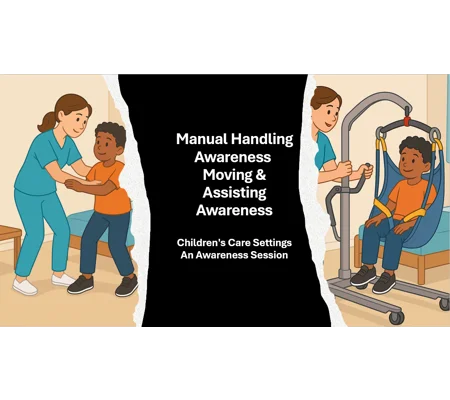
Manual Handling, Moving and Assistance Awareness - Childrens Care SettingsManual Handling, Moving and Assistance Awareness - Children's Care Settings Presentation, Handouts, End of Session Quiz (mix of Multiple Choice, True/False, Short Answer Questions). All files editable. This is a general awareness session to accompany mandatory practical training and competency assessment. Aims and Objectives Overall Aim: To raise awareness of safe, respectful and effective manual handling and assisting practices when supporting children in care settings. Learning Objectives: Understand the key risks and responsibilities involved in manual handling and assisting children. Recognise the importance of communication, planning and teamwork in supporting safe movement. Identify appropriate handling techniques and the correct use of equipment in different care scenarios. Develop awareness of legal, ethical and safeguarding considerations when moving and assisting children. Presentation (46 Slides) Aims and Objectives Welcome Introduction What is Manual Handling? Importance...
Presentation Packs
MARSI Awareness Wound Care Training ResourcesWound Care MARSI 1) MARSI Awareness 2) Reducing the Risk of an Allergic Skin Reaction Presentation 1 MARSI Awareness (33 Slides) This session gives an awareness of medical adhesive-related skin injury (MARSI) The importance of understanding MARSI What a MARSI is, categories of MARSI and how they occur Who is at risk of a MARSI and the consequences of a MARSI How risks can be reduced How to report an incident Slide Titles: Aims and Objectives Introduction Factors of MARSI 2010 Study Medical Adhesive Products or Devices Medical Adhesive-Related Skin Injury Reporting of MARSI Who is at Risk? Consequences of MARSI Prevention of Medical Adhesive-Related Skin Injury How else can Risks be Reduced? Those Particularly at Risk Consequences of MARSI Causes Range of Injuries International Skin Tear Advisory Panel (ISTAP) Definition of a Skin Tear Categories of MARSI 1) Mechanical Categories of MARSI 2) Dermatitis Categories of MARSI 3) Other Risk Factors Neonates and Paediatrics Older Adults De...

Presentation Packs
Medication and Feeding Tubes Clinical Training ResourcesHow Enteral Feeding Tubes Affect Medicines - Safe and Effective Practice in Clinical Settings Presentation, Handout, Knowledge Check Questions, Trainer Aide Answer Key. All files editable. Overall Aim: To provide healthcare professionals with the knowledge and practical skills to understand how enteral feeding tubes affect medicines, so they can ensure safe, effective and evidence-based administration of drugs to patients receiving enteral nutrition in line with best practice. Learning Objectives: Understand types and functions of enteral feeding tubes. Recognise how tube feeding affects drug absorption and efficacy. Select appropriate dosage forms for enteral administration. Identify common drug feed interactions. Apply best practices for safe drug administration via feeding tubes. Minimise and manage the risk of tube blockages. Presentation (49 Slides) Aims and Objectives Overview of Enteral Feeding Tubes Indication for Use Practice Context How Tubes Affect Medicines Altered Drug ...
Presentation Packs
Medication Barcoding Systems Awareness Training ResourcesMedication - Barcoding Systems Awareness Health and Social Care Teaching/Training Resources All fully editable. Presentation (15 slides). Aims and Objectives included if you want to use the presentation as it has been written. Comes with a Handout and Multiple Choice End of Session Assessment. Overall Aim: To gain awareness of barcoding systems in health and care in medication administration, to enhance accuracy, reduce errors and improve safety Learning Objectives: Understand the fundamental principles of how barcoding systems work Recognise the significant benefits of barcoding systems in reducing medication errors Gain insights into the broader advantages of barcoding systems Appreciate the key considerations for successful implementation of barcoding systems Presentation Aims and Objectives Introduction Reducing Medication Administration Errors Barcoding Systems How Barcoding Systems Work ( Barcode Generation, Medication Packaging) How Barcoding Systems Work ( Patient Identifica...
Presentation Packs
Medication Domiciliary Care Training ResourcesDomiciliary and Home Care - Medication Suitable for domiciliary, home care agencies, personal assistants and training organisations etc. Presentation 1 Safe Handling, Management and Administration of Medication by Carers within Domiciliary Care General Principles Overview (22 slides) Slide Titles: Risk Assessment Promoting Independence Consent Legislation Covert Administration Forced Administration Medication Containers Concerns Types of Support Records Presentation 2 Safe Handling, Management and Administration of Medication by Carers within Domiciliary Care Policy (42 slides) Slide Titles: Scope of a Medication Policy Aims of a Policy Roles and Responsibilities Organisational Responsibilities Support Worker Responsibilities Risk Assessment Medication Reviews Capacity and Consent Standards (England, Wales, Scotland and N.I) Presentation 3 Safe Handling, Management and Administration of Medication by Carers within Domiciliary Care Types Of Support (20 slides) Slide Titles: Level 1 A...
Presentation Packs
Medication Effects on Body Temperature Training ResourcesMedications and Their Effects on the Ability to Regulate Body Temperature Awareness Presentation, Handouts and End of Session Assessment Aim: To educate the audience about the impact of medications on body temperature regulation and heat sensitivity, providing insight into the potential risks and considerations associated with medication use in various situations Learning Objectives: Understand how antipyretic medications can be used to manage fever and regulate body temperature during illnesses Identify the categories of medications that affect the central nervous system and learn how they may influence body temperature awareness and regulation Recognise medications with anticholinergic properties and their potential to interfere with sweating and heat sensitivity Gain awareness of medications that can increase heat sensitivity and the precautions individuals should take to mitigate potential risks Presentation Aim Objectives Introduction Types of Medications Fever-Reducing Medicat...

Presentation Packs
Medication Management Audits Residential Care Training ResourcesResidential Care - Medication Management Audits Awareness Presentation, Handout and Multiple Choice End of Session Assessment All files editable. The THIRD of a series of packs on Care Auditing in Adult Residential Care Homes Aims and Objectives: Overall Aim: To provide learners with the knowledge and skills to conduct medication management audits that promote safe, effective and compliant practices in adult residential care settings. Learning Objectives: Understand the purpose and importance of medication management audits in ensuring safety and regulatory compliance. Identify key areas of focus, including documentation, administration practices and storage requirements, during a medication audit. Develop the ability to use audit tools, report findings and create action plans to improve medication management practices. Presentation (32 Slides) Aims and Objectives Introduction Purpose of Medication Audits Key Regulations and Guidelines Common Risks and Issues Preparing for a Medicat...
Presentation Packs
Medication Safe Handling Management Administration Training ResourcesSafe Handling, Administration and Management of Medication Fully comprehensive and detailed presentations covering every aspect of Managing and Safe Handling of Medicines in a Care Setting. The information contained in this training pack meets the standards set by the Care Quality Commission, National Minimum Standards, Outcomes and Standards for adult care settings. Presentation 1 - Introduction to Medicines in a Care Setting (78 Slides) - Slide Titles: Introduction to Medication Definition of the Term Medicine Categories and Types of Medicines Knowledge of Medicines Forms of Medicines Benefits of Medicine Risks associated with medicines Risk Assessments Roles and Responsibilities Presentation 2 - Receiving, Disposing & Storing of Medicines within a Healthcare Setting (101 slides) Slide Titles: Legislation Policies and Procedures Prescribing of Medicines Sources of Medication Record Keeping Storage of Medication Temperature Control Cold storage Storage of Oxygen Disposal of Medicin...

Presentation Packs
Medication Safer Practice Beyond MAR Charts Training ResourcesSafer Medication Practice Beyond MAR Charts Strengthening safe medication culture and building cqc inspection ready confidence . Target Audience: Senior Carers | Nurses | Deputies | Medication Leads Presentation, Handouts and Learning Activities. All files editable. Overall Training Aim: To strengthen safe medication systems, documentation standards and leadership oversight so that medication practice is transparent, accountable and inspection-ready. Learning Objectives: Define medication errors and near misses and understand their governance implications. Record medication incidents and administration using clear, objective and factual documentation. Explain and apply the essential components of safe PRN protocols, including evaluation of effectiveness. Identify common medication risks within care settings and how to prevent them. Describe effective medication auditing processes and how findings inform improvement. Recognise the leadership responsibilities required to maintain safe...

Presentation Packs
Medication Safety Domiciliary Care Level 1 Training ResourcesMedication Safety Domiciliary Care Level 1 Training Resources Presentation, Handout, Knowledge Check Questions, Trainer Aide Answer Key. All files editable. Overall Learning Aim: Learning outcomes: To give domiciliary care staff a basic awareness of medication safety, including safe administration, storage, recording and monitoring when supporting people in their own homes. Understand what medication safety means. Know some basic safety checks before medication is given. Understand how medicines should be stored safely. Know why medication must be recorded correctly. Recognise when there may be a problem with medication. Know when and how to report concerns. Know where to get help and advice. Presentation (41 Slides) - Slide Titles: Aim and Objectives Introduction What Is Medication Safety? Why Is Medication Safety Important? Your Role in Medication Safety Basic Medication Safety Checks Checking the Person Before Giving Medication Checking the Medication Supporting Medication Safely...

Presentation Packs
Medication Safety Residential Care Level 1 Training ResourcesMedication Safety Residential Care Level 1 Training Resources Presentation, Handout, Knowledge Check Questions, Trainer Aide Answer Key. All files editable. Overall Learning Aim: To give care staff a basic awareness of medication safety, including safe administration, storage, recording and monitoring, and the importance of following agreed procedures. Learning outcomes: Understand what medication safety means. Know some basic safety checks before medication is given. Understand how medicines should be stored safely. Know why medication must be recorded correctly. Recognise when there may be a problem with medication. Know when and how to report concerns. Know where to get help and advice. Presentation (39 Slides) - Slide Titles: Aim and Objectives Introduction What Is Medication Safety? Why Is Medication Safety Important? Your Role in Medication Safety Basic Medication Safety Checks Checking the Person Before Giving Medication Checking the Medication Giving Medication Safely Suppor...

Presentation Packs
Menopause Awareness Training ResourcesMenopause Awareness - A Guide for Nurses and Healthcare Staff Health and Social Care Teaching/Training Resources All fully editable. Presentation in sections you can choose which sections to use. Aims and Objectives included if you want to use the presentation as it has been written. Comes with a 16 Page Handout, Quiz, Suggested Role Play Activities and a multiple choice end of session assessment. Overall Aim: To equip Nurses and Health Care Staff with the knowledge and skills to provide empathetic and informed care to individuals experiencing menopause while fostering a supportive and inclusive work environment Learning Objectives: Understand the physiological and psychological aspects of menopause. Recognise the impact of menopause on physical and mental health. Develop effective communication skills for discussing menopause with patients. Identify workplace considerations and strategies for creating a supportive environment. Promote self-care and well-being among healthcare profe...

Presentation Packs
Mental Capacity and Best Interests Awareness Children's Residential Care Training ResourcesMental Capacity and Best Interests Awareness in Childrens Residential Care Settings All editable documents. This is the FIRST pack of a set of resources for Childrens Residential Care on this topic. This pack introduces the principles and basic underpinning knowledge for care staff, along with interactive case studies for general situations that care staff will come across. The SECOND pack focuses on more challenging aspects of mental capacity and best interests (e.g. mobile phones and internet usage) and is available separately. Both packs together would enable trainers to put together a one day or one and a half day training session. This pack has 10 Files in total (Presentation (in section) , Handouts x 5, Case Studies x 10 for interactive learning and End of Session Multiple Choice Assessments x 4 (one for each learning objective. Overall Aim: To provide participants with a comprehensive understanding of how the Mental Capacity Act (MCA) and Deprivation of Liberty Safeguards (Do...

Presentation Packs
Mental Capacity DoLs & LPS Level 1 Training ResourcesMental Capacity DoLs & LPS Level 1 Training Resources Presentation, Handout, Knowledge Check Questions, Trainer Aide Answer Key. All files editable. Overall Learning Aim: To understand the basic principles of the Mental Capacity Act and Liberty Safeguards and how they help protect people's rights and choices . Learning outcomes: Know what the Mental Capacity Act is. Understand what mental capacity means. Know how to support someone to make their own decisions. Know what best interests means. Know what DoLS are and why they are used. Know that LPS are not currently in force. Know what to do if they are worried about a person's rights or freedom. Presentation (41 Slides) - Slide Titles: Overall aim and outcomes Introduction What is the Mental Capacity Act? What Does Mental Capacity Mean? Supporting Someone to Make a Decision The 5 Principles of the Mental Capacity Act Making an Unwise Decision When Someone Cannot Make a Decision What Does 'Best Interests' Mean? What is a Restriction? ...